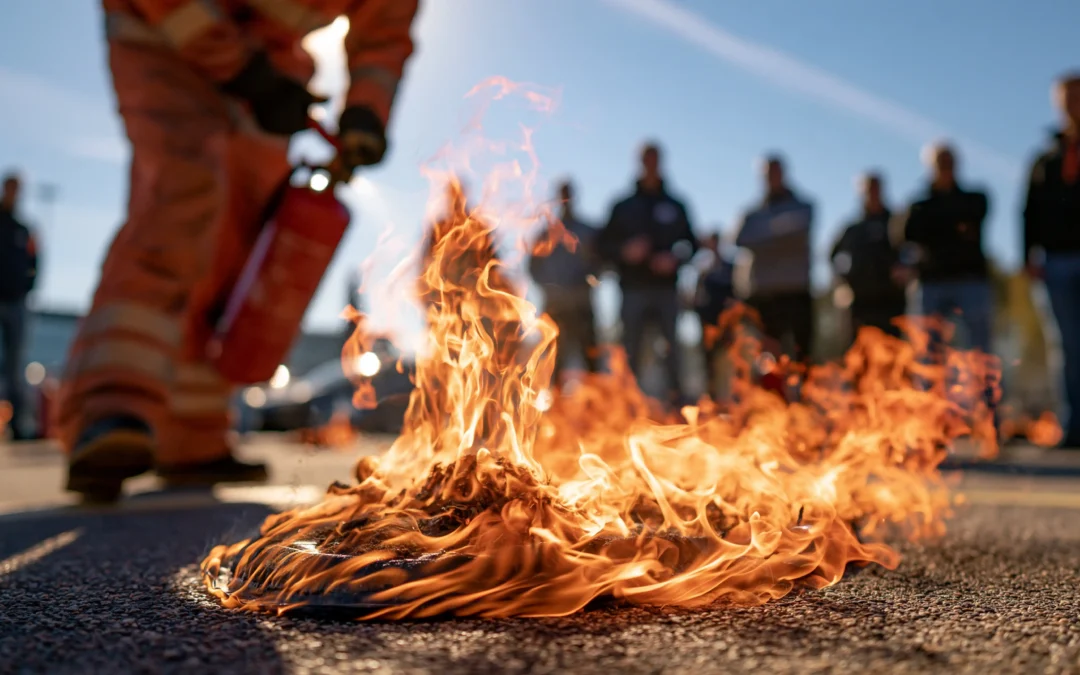
Fire extinguisher training for employees in Michiana helps workers understand what to do when a fire starts. It also teaches them when evacuation is the safer response. At M&M Fire Protection and Security, we help commercial facilities across Goshen, Elkhart, South Bend, and the Michiana region. We maintain fire protection equipment that supports a prepared workplace.
Key Takeaways
- RACE stands for Rescue, Alarm, Contain, and Extinguish. It provides a clear sequence for workplace fire emergency response.
- PASS stands for Pull, Aim, Squeeze, and Sweep. It describes the basic steps for operating a portable fire extinguisher.
- OSHA requires extinguisher education when portable extinguishers are provided for employee use. Education is required initially and at least annually thereafter.
- Employees should consider extinguisher use only when workplace procedures allow it. A safe escape route should always remain available.
How Employees Apply RACE and PASS During Fire Emergencies
RACE and PASS serve different purposes during a workplace fire emergency. RACE provides the broader response sequence. PASS focuses specifically on operating a portable fire extinguisher.
Rescue Comes Before Any Extinguisher Use
The first step in the RACE fire emergency procedure is rescue. This means helping people in immediate danger move toward safety when conditions allow. Employees should never put themselves or others at unnecessary risk.
Busy Michiana workplaces include manufacturing facilities, restaurants, schools, churches, and other commercial buildings. Employees in these facilities should know their evacuation routes before an emergency occurs. They should also understand where designated exits are located.
Alarm Activation Alerts the Whole Building
The second RACE step is alarm activation. Employees should follow established procedures for activating the fire alarm and notifying emergency responders.
In buildings with monitored fire alarm systems, signals may also reach a monitoring service. This depends on the building’s system configuration. Pull stations and other alarm devices should remain visible and accessible. Clear access helps employees act quickly during an emergency.
Containing the Fire Limits Its Spread
Containment involves closing doors behind you when appropriate and safe. This action can help limit the movement of fire and smoke. Employees should never delay evacuation or put themselves in danger simply to contain a fire.
A broader fire safety program can help commercial facilities establish clearer emergency procedures. These procedures are important for businesses throughout Goshen, Elkhart, South Bend, and the broader Michiana region.
Extinguishing Only Applies to Small, Contained Fires
The final RACE step applies only when workplace procedures permit extinguisher use. The fire should remain in its incipient stage. Employees should also have an unobstructed escape route and an appropriate extinguisher.
The OSHA guidance for portable fire extinguishers explains employer responsibilities for employee education. It also addresses hazards associated with incipient-stage firefighting. If conditions become unsafe or the fire grows, employees should evacuate.
Pulling the Pin Unlocks the Extinguisher
The PASS fire extinguisher method starts with pulling the pin. Removing the pin allows the extinguisher to be operated.
Employees should also recognize signs of previous use, damage, or other problems. A questionable extinguisher should be reported rather than assumed ready for an emergency. Routine inspections and maintenance help facilities keep portable extinguishers available for their intended purpose.
Aiming Low Targets the Fuel Source
The second PASS step is aiming the nozzle at the base of the fire. Employees should not aim at the flames above it. Aiming low directs the extinguishing agent toward the burning material.
Workplace fire extinguisher training should clearly explain this step. Employees should understand the procedure before they are expected to respond during an actual emergency.
Squeezing and Sweeping Completes the Discharge
Employees then squeeze the handle to release the extinguishing agent. They sweep the nozzle from side to side across the fire’s base.
Employees should continuously monitor conditions and maintain access to their escape route. If the extinguisher is ineffective, they should stop attempting extinguishment. Worsening conditions also signal that employees should evacuate according to the facility’s emergency plan.
Workplace Fire Response Priorities for Michiana Teams
Knowing how employees should use a fire extinguisher is only one part of workplace preparedness. Employers also need appropriate procedures, equipment, and training. These elements should reflect the hazards employees may encounter at their facility.
Matching Extinguisher Type to Facility Hazards
Different workplace hazards require appropriate extinguisher classifications. The OSHA fire protection guidance identifies five common fire classifications. Class A covers ordinary combustibles. Class B covers flammable liquids or gases. Class C involves energized electrical equipment.
Class D applies to combustible metals. Class K covers fires involving cooking oils and fats. A Goshen restaurant and an Elkhart RV manufacturing facility can have very different extinguisher needs. Facility-specific planning is therefore an important part of fire extinguisher safety training.
Annual Training Keeps Compliance Current
Under OSHA’s portable fire extinguisher standard, employers must provide education when extinguishers are available for employee use. This education covers general extinguisher-use principles and hazards associated with incipient-stage firefighting.
Education is required upon initial employment and at least annually thereafter. Employees designated to use firefighting equipment also need appropriate equipment training. That training is required upon initial assignment and at least annually thereafter.
Training Documentation Keeps Records Organized
Employers should maintain clear workplace fire extinguisher training records. Records help track employee participation and identify when refresher education is due.
Training records can also support consistent procedures across multiple locations. Michiana organizations may operate several buildings, departments, or shifts. A consistent recordkeeping process helps employers identify training gaps and keep employee fire safety procedures organized.
Practical Training Reinforces Safe Extinguisher Use
Practical instruction can connect the PASS steps with equipment available in the workplace. Training can reinforce extinguisher selection, safe positioning, escape-route awareness, and evacuation procedures.
Employees should understand when they must evacuate instead of continuing to fight a fire. Workplace fire extinguisher training should not encourage unnecessary risk. Instead, training should make approved procedures easier to understand before an emergency occurs.
Exit and Emergency Lighting Supports Safe Evacuation
Fire extinguisher safety training should work alongside an effective evacuation plan. Exit and emergency lighting helps occupants identify evacuation paths when normal lighting becomes unavailable.
These systems are another part of broader workplace fire emergency response planning. Michiana facilities should include them when reviewing their overall fire protection procedures. Employees should not rely on extinguisher knowledge alone during a fire emergency.
Designating Response Roles Reduces Confusion
Employers should clearly identify which employees, if any, are designated to use firefighting equipment. Other employees may be expected to evacuate instead.
OSHA requirements vary depending on how extinguishers are provided and how employees are assigned. The facility’s emergency action plan should reflect those responsibilities. Clearly communicating employee roles can reduce uncertainty when workers must make quick decisions.
Coordinating Fire Protection Systems Supports Response
Fire alarms, monitoring, extinguishers, and emergency lighting support different parts of workplace fire response. Maintaining these systems within a coordinated safety program can help create clearer emergency procedures.
Michiana businesses can develop procedures covering detection, notification, initial response, and evacuation. Employees can then train around the equipment and procedures that apply to their specific building.
Building a Fire-Ready Workplace in Michiana
Employee training works best when the equipment and systems workers depend on are properly maintained. A coordinated approach supports detection, response, and evacuation. It also prevents extinguisher training from becoming an isolated workplace safety activity.
M&M Fire Protection and Security has served the Michiana region since 1993. We support commercial organizations with fire protection and security services.
Contact us to discuss your building’s needs.
Frequently Asked Questions
Do employees need training on using fire extinguishers?
When employers provide portable extinguishers for employee use, OSHA requires education covering general extinguisher-use principles and incipient-stage firefighting hazards. Education is required upon initial employment and at least annually thereafter under 29 CFR 1910.157(g).
Do you have to be certified to teach fire extinguisher training?
OSHA’s portable fire extinguisher standard does not specify a particular trainer certification in 29 CFR 1910.157(g). Employers remain responsible for providing required education and appropriate equipment training for designated employees.
What is the OSHA requirement for fire extinguisher training?
Under 29 CFR 1910.157(g), employees provided extinguishers for workplace use receive education initially and at least annually thereafter. Employees designated to use firefighting equipment also receive appropriate training upon initial assignment and annually thereafter.
What are the 5 basic classes of fire extinguishers?
The five common fire classes are Class A, Class B, Class C, Class D, and Class K. They cover ordinary combustibles, flammable liquids or gases, energized electrical equipment, combustible metals, and cooking oils and fats.