
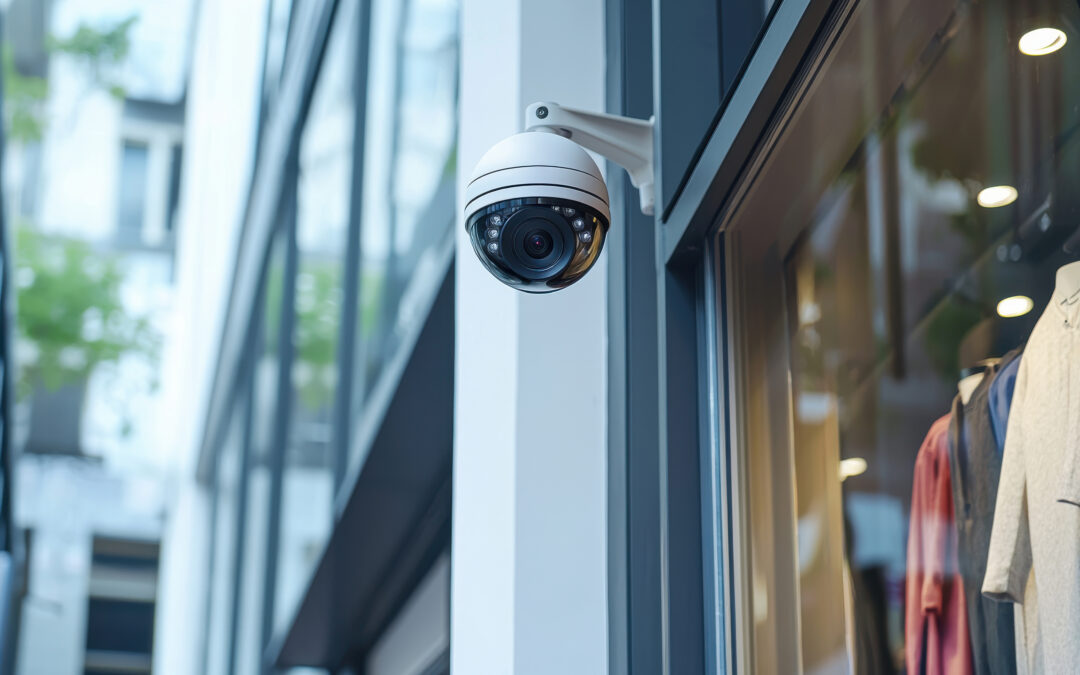
Commercial video surveillance systems give business operators real-time visibility into daily activity and potential threats. At M&M Fire Protection and Security, we help commercial property owners and facilities managers across the Michiana region design camera systems. Each system is built to align with operational risk, compliance requirements, and long-term goals.
Key Takeaways
- Commercial video surveillance systems capture, transmit, and store digital footage for live monitoring and post-incident review.
- IP-based camera systems with Network Video Recorders deliver high-resolution video, scalable storage, and flexible placement compared to analog setups.
- Night-vision capability, Power-over-Ethernet wiring, and selective wireless deployment expand coverage across parking lots and loading areas.
- Integrated systems connect cameras with access control and alarm events to create clearer investigative records.
- Proper planning around storage and scalability prevents costly redesigns as facilities grow.
Ways Video Surveillance Improves Risk Monitoring for Michiana Businesses
Effective surveillance begins with understanding how each component performs in real conditions. When cameras, recorders, and network infrastructure work together, businesses gain actionable insight instead of passive recordings.
Cameras Capture and Transmit Video
Modern IP-based cameras encode video at the lens and transmit digital footage over a standard Ethernet network. Unlike analog systems that rely on coaxial cable and centralized processing, IP-based systems provide sharper resolution and remote configuration. Businesses exploring upgraded commercial camera systems often choose IP technology because it supports expansion without replacing core infrastructure.
For Goshen, Elkhart, and South Bend facilities with multiple buildings or extended production floors, this flexibility simplifies layout planning. Cameras can monitor entrances, warehouse aisles, and parking areas without complex rewiring. High-resolution footage improves identification accuracy during investigations.
According to the FBI Crime Data Explorer, property crime remains a concern for commercial properties nationwide. Clear video evidence improves the likelihood of identifying individuals and vehicles. In manufacturing-focused areas of Northern Indiana and Southern Michigan, video clarity also supports internal safety reviews and quality-control investigations.
Network Video Recorders Store Footage
The Network Video Recorder serves as the central hub of an IP-based surveillance system. It records, stores, and manages footage from connected cameras while allowing authorized users to search and export clips. Retention time depends on resolution, compression format, camera count, and recording mode.
Facilities throughout the Michiana region often align storage decisions with insurance requirements and internal policy. When cameras integrate with broader security systems, managers gain centralized oversight. Door access logs, alarm triggers, and camera footage can be reviewed together for a clear timeline.
Guidance from organizations such as ASIS International supports layered security strategies. In this model, video functions as both a deterrent and a verification tool. Coordinated systems reduce confusion during incident response and simplify documentation.
Night-Vision Technology Extends Coverage in Low-Light Conditions
Infrared-enabled cameras capture usable footage even in zero visible light. This capability is critical for parking areas, loading docks, and fenced perimeters where risk often increases after hours. Specifications typically list the infrared range in feet, helping businesses match equipment to actual distances.
Consistent nighttime coverage supports life-safety planning referenced by the National Fire Protection Association. When surveillance overlaps with emergency egress routes or high-value storage areas, visibility remains uninterrupted. In distribution centers and RV manufacturing facilities across Northern Indiana, extended coverage protects assets and employees during overnight shifts.
Key Considerations When Planning a Surveillance Strategy
System performance depends on structured planning rather than equipment alone. Clear objectives and practical constraints should guide each installation.
Define Your Coverage Objectives Before Selecting Equipment
Before selecting cameras, define what must be monitored and why. Entry points, cash-handling areas, server rooms, production lines, and parking lots present different risk profiles. A structured walk-through helps identify blind spots and avoid overlapping coverage.
When video pairs with professional monitoring services, alerts can be verified quickly. Verified response reduces unnecessary dispatches and improves coordination with authorities. Clearly defined objectives also guide lens selection.
Wide-angle lenses suit warehouse floors, while tighter focal lengths capture doorways and transaction counters effectively.
Determine the Best Wired or Wireless Deployment for Your Facility
Power-over-Ethernet technology allows one cable to deliver power and data to each camera. This configuration remains standard for permanent commercial installations because of stability and predictable uptime. Reinforced concrete and steel framing, common in Michiana facilities, can interfere with wireless signals.
Wireless deployment may support detached structures or temporary job sites. However, reliability, bandwidth capacity, and interference must be evaluated carefully. A professionally designed system balances installation efficiency with long-term performance.
Align Storage Capacity With Retention and Compliance Needs
Retention policies vary by industry, insurance carrier, and regulation. Higher-resolution cameras consume more storage, especially during continuous recording. Motion-triggered recording reduces storage use while preserving footage during active events.
Operations managers should confirm required retention periods and whether archived clips need off-site backup. Aligning resolution settings, retention windows, and export procedures with operational goals keeps systems compliant and cost-effective. Planning for future expansion ensures the system can scale without full replacement.
Protect Your Michiana Business With a Purpose-Built Surveillance System
A surveillance system should reflect your facility, risk profile, and long-term plans. Integration and professional installation make a measurable difference.
M&M Fire Protection and Security has served commercial customers across Northern Indiana and Southern Michigan since 1993. We design and install integrated fire alarm and security solutions for facilities in Goshen, Elkhart, South Bend, and surrounding communities.
If you are evaluating business security cameras or upgrading an existing CCTV system, contact us to schedule a site consultation.
Frequently Asked Questions
What is the best commercial surveillance system for a business?
The best system depends on facility size, coverage goals, and infrastructure. Most commercial properties benefit from IP-based cameras paired with an NVR. A professional site assessment clarifies placement, resolution, storage capacity, and integration requirements.
How much does a commercial security camera system cost?
Costs vary based on camera count, resolution, building layout, and labor. Small systems may start in the low thousands, while large deployments increase significantly. Accurate pricing requires defined coverage objectives and an on-site evaluation.
Which is better for commercial use, a DVR or an NVR system?
NVR systems are typically preferred for new installations because they support IP-based cameras, higher resolution, and easier scalability. DVR systems rely on analog cameras and coaxial cable, which can limit flexibility and expansion.
Can commercial video surveillance systems work without a subscription?
Yes. Many systems store footage locally on an NVR without recurring cloud fees. Subscriptions generally apply only when cloud backup storage or third-party monitoring is added.